Ben Harvey
A FALLOW MIND
“When the sun began to fade, we didn’t flee. We remembered. ”
You are an Archivist, tasked with maintaining the Prism Vault: a living database of the world's remaining flora. In a land where light is a rare and shifting currency, you must use tactical logic and kinetic chain-shifting to cultivate life from the dust. Build your sanctuary, restore the seeds of the past, and awaken A Fallow Mind.
Design Pillars
Pillar 1: The Patient Plot
The Vision: Traditional farming sims often marry long-term goals with real-time pressures, forcing players to react to the dictation of an ever-moving clock. A Fallow Mind decouples the progress of time and places agency back in the player's hands. By shifting from a reflexive loop to a turn-based Action Point (AP) economy, we transform the mechanical chores of the genre into a series of meaningful, tactical decisions.
Pillar 2: Chase The Sun
The Vision: Crop growth in A Fallow Mind is never a passive process, its a negotiation with an ever-changing environment. Sunlight is a localized and shifting resource, turning the field into a dynamic board where spatial awareness is the key to success. Players must treat their crops as movable components in a larger machine, utilizing Chain Shifting to move complex tray arrangements and optimize their yields. By making the farm kinetic, we transform the land from a static aesthetic into a rewarding landscape of light, shadow and natural entropy.
Pillar 3: Room To Fail
The Vision: In a world of tactical optimization, every action - from sowing a seed to "chain-shifting" a tray arrangement - is a deliberate expenditure of the player's most precious resource: Time. To ensure the strategic depth remains meditative rather than stressful, A Fallow Mind provides a robust safety net. By utilizing an undo buffer and the ability to "bank" Action Points for future turns, the game encourages risk-free experimentation. Players are never forced to commit to a move until they are satisfied with their tactical solution, ensuring that the progression of time is always a conscious choice.
Pillar 4: A Legacy Sown
The Vision: Tactical mastery in the field is not an end in itself, but the fuel for a persistent sanctuary. A Fallow Mind connects the intellectual rigor of the "Field" to the emotional rewards of the "Haven." By converting tactical yields into meaningful reinvestment—ranging from utility-based tools to purely aesthetic expansions—we create a compelling meta-game loop. The player’s farm serves as a living trophy room, where every solution found in the dirt leaves a permanent mark of progress on their home.
Design Decisions
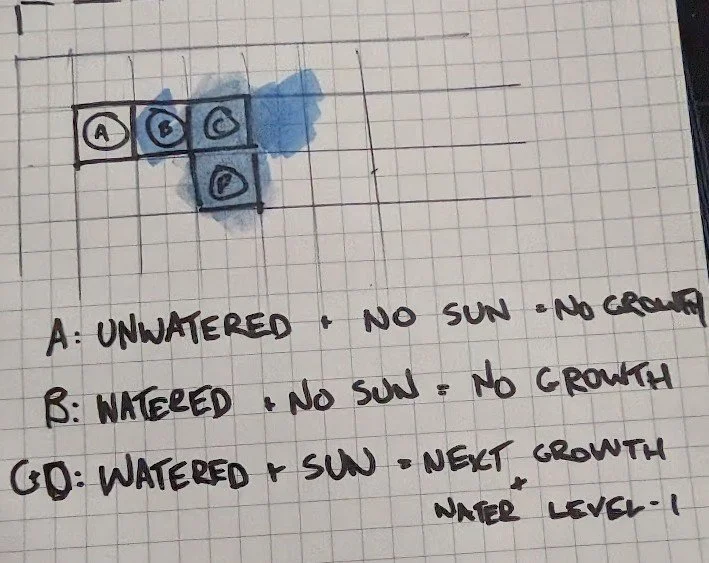
The Photosynthetic Loop
Input: Sun Position + Water Resource.
Process: GridLogic iterates only lit tiles
Condition: If (Sun + Water) -> Advance Phase Index.
Outcome: Economy generation via ShippingBin buffer after reaching final growth phase
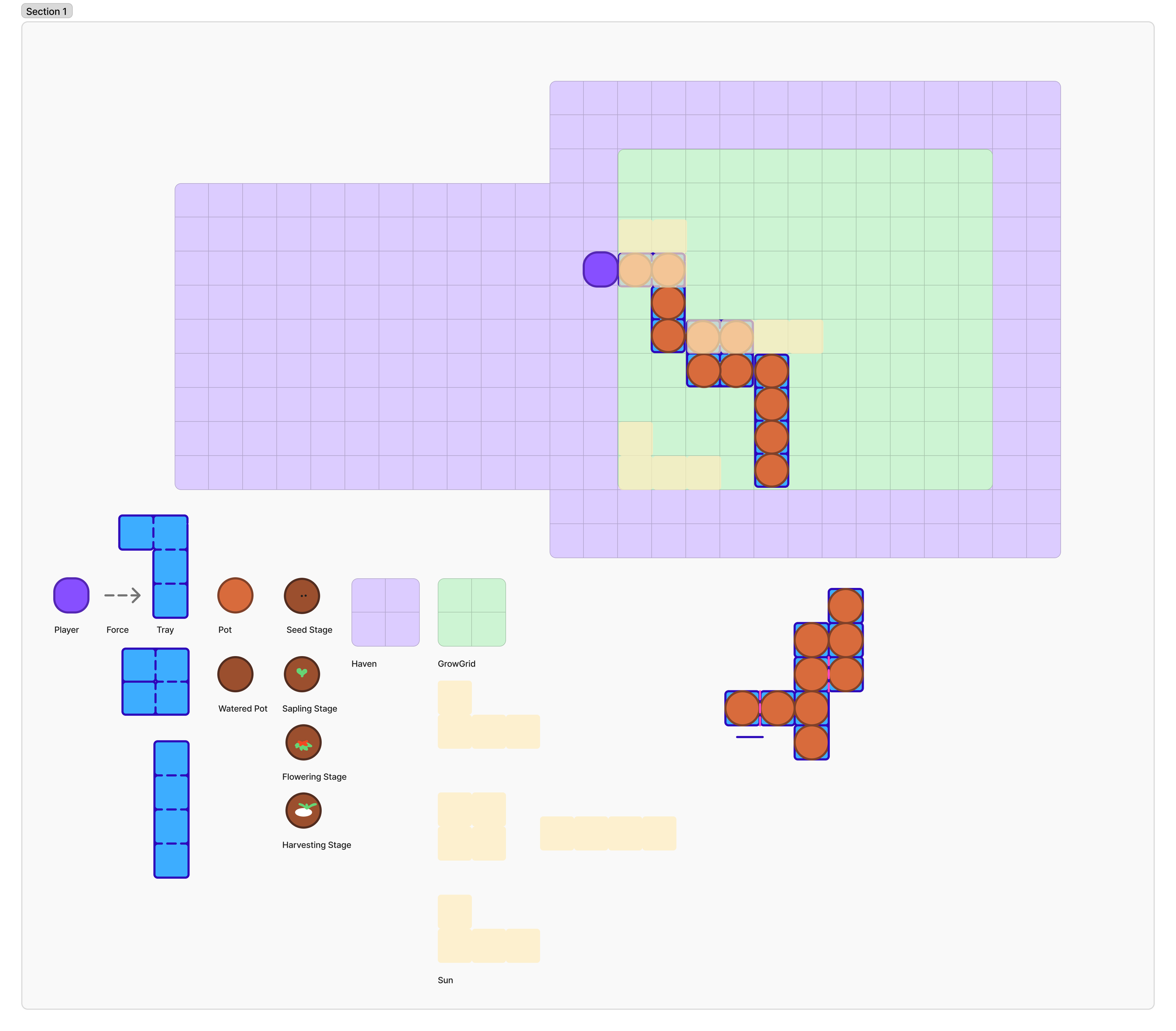
Prototyping design stage
The Time Economy: The Global AP Heartbeat
The Decision: 5 Player Actions = 1 World Tick (30 Minutes).
The Problem: Traditional "real-time" clocks in farming games create stress and punish slow thinkers.
The Solution: A deterministic "Heartbeat." Time only moves when the player acts.
The Safety Net: The 1-Tick Undo Buffer
The Decision: A 5-action rewind window that closes only when the clock moves forward.
The Problem: In a tactical game, one misclick can ruin a 20-minute plan, leading to frustration.
The Solution: A state-cloning system that saves the world state at the start of every 5-AP block.
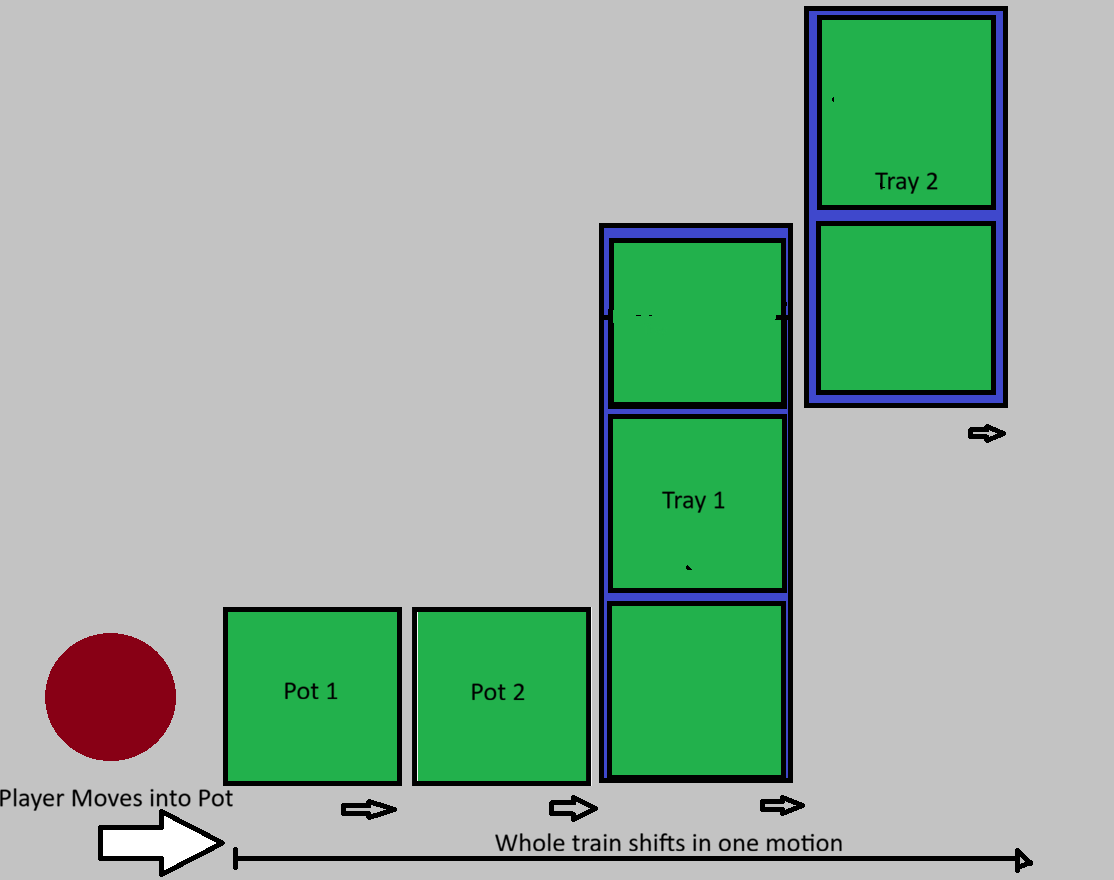
Spatial Logic: Recursive Force Propagation (Chain-Shifting)
The Decision: Trays move in "Trains." Pushing one pushes all connected trays.
The Problem: Moving 10 pots one by one is tedious and spends too much AP. Game time progresses too fast if players are interacting and moving.
The Solution: Logic that "tunnels" force through a chain. One push moves the whole assembly using recursive force propagation through each tray within train. Any obstacle in the path of any of the trays blocks the whole chain movement
The Result: Moving Large links feels more efficient and makes the gameplay less tedious
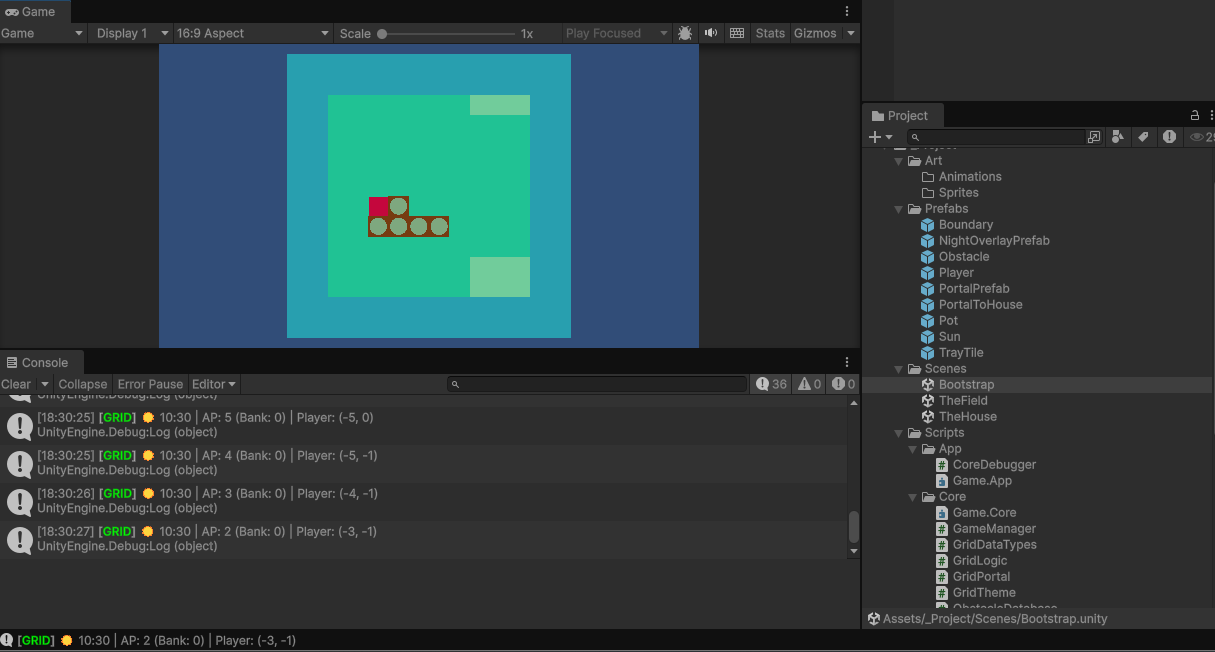
Unity Prototyping Stage
Economic Balance: The Interaction Tax
The Decision: Adjacency-based interaction costs 1 AP, even in the "Safe" Haven.
The Problem: The Haven border created an exploit where players could farm for "free" without time passing.
The Solution: Decoupling "Movement" (0 AP in Haven) from "Interaction" (1 AP everywhere).
The Architecture: Decoupled MVC (Pure C#)
The Decision: I’m choosing to keep the game’s core logic (the "Model") completely separate from the Unity Engine.
The Problem: Unity Editor code is hard to test and can become "spaghetti" where visuals and logic are tangled.
The Solution: All grid logic, plant growth, and AP calculations are "Pure C#." They don't know Unity exists.